
Introduction
Foreign companies doing business in India need to comply with various Indian tax and regulatory requirements. Depending on their activities, income, turnover, and applicable provisions, they may also have tax audit obligations under the Income-tax Act.
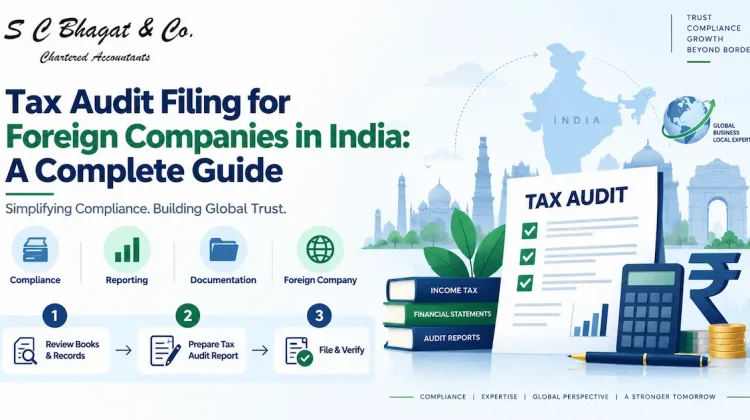
Tax Audit Filing for Foreign Companies in India involves reviewing financial records, determining the applicable tax requirements, preparing the prescribed audit report, and completing the relevant income tax compliance within the applicable timelines.
Understanding these requirements is important for foreign companies operating through an Indian presence, permanent establishment, branch, project office, or other taxable business arrangements.
What Is a Tax Audit?
A tax audit is an examination of specified financial records and information to determine whether the taxpayer has complied with applicable provisions of the Income-tax Act.
Where tax audit provisions apply, a Chartered Accountant examines the relevant books and records and furnishes the prescribed tax audit report.
The audit may cover areas such as:
- Business income and expenses
- Revenue and receipts
- Financial statements
- Depreciation
- Tax deductions
- TDS compliance
- Related-party transactions
- Other information required under the applicable tax audit provisions
Do Foreign Companies in India Need a Tax Audit?
A foreign company does not automatically become liable for a tax audit simply because it is a foreign entity.
The requirement depends on the applicable provisions of Indian tax law and the nature and scale of its activities in India.
For example, a foreign company may have Indian tax exposure through:
- A branch office
- A permanent establishment
- A project office
- Business operations in India
- Other taxable presence or income in India
The applicability of tax audit should therefore be evaluated based on the company’s specific facts, accounting records, business activities, and relevant provisions of the Income-tax Act.
Why Is Tax Audit Important for Foreign Companies?
Foreign companies often deal with additional tax and reporting complexities because their Indian operations may be connected with an overseas head office or group entities.
A proper tax audit can help identify issues relating to:
- Revenue reporting
- Business expenses
- TDS
- Depreciation
- Related-party transactions
- Transfer pricing
- Permanent establishment considerations
- Reconciliation of financial information
- Tax return disclosures
Early identification of discrepancies can help the company address compliance issues before they become more complicated.
Key Steps in Tax Audit Filing for Foreign Companies in India
1. Determine Tax Audit Applicability
The first step is to determine whether the foreign company is subject to tax audit under the applicable provisions.
This assessment should consider:
- Nature of Indian operations
- Turnover or gross receipts
- Business structure
- Taxability in India
- Applicable provisions of the Income-tax Act
- Relevant exemptions or special provisions
Professional advice can be particularly useful where the company has complex cross-border transactions.
2. Maintain Proper Books and Financial Records
Foreign companies operating in India should maintain appropriate accounting records for their Indian operations.
These may include:
- Sales and revenue records
- Purchase records
- Expense documentation
- Bank statements
- Payroll records
- Fixed asset records
- General ledgers
- Invoices
- Tax payment records
Proper records provide the foundation for tax audit and income tax return preparation.
3. Review Revenue and Expenses
The tax auditor reviews the financial information relevant to the Indian operations.
The review may include:
- Revenue recognition
- Business expenses
- Employee costs
- Depreciation
- Professional fees
- Administrative expenses
- Payments to related parties
The objective is to ensure that the financial information reported for tax purposes is properly supported.
4. Review TDS Compliance
Tax Deducted at Source (TDS) is another important area of compliance.
Foreign companies making applicable payments in India may have TDS obligations.
The review may cover:
- TDS deductions
- Deposits
- TDS returns
- Certificates
- Reconciliation of TDS information
Errors or mismatches should be identified and addressed as early as possible.
5. Review International and Related-Party Transactions
Foreign companies may have transactions with their overseas parent company, associated enterprises, or other group entities.
These transactions may require additional tax analysis, including transfer pricing considerations where applicable.
Examples include:
- Management fees
- Technical service fees
- Royalty payments
- Cost allocations
- Reimbursements
- Loans or financing arrangements
- Purchase or sale of goods
Proper documentation and reporting are important for cross-border tax compliance.
6. Prepare the Applicable Tax Audit Report
Where tax audit is applicable, the Chartered Accountant prepares the prescribed tax audit report and relevant annexures or statements in accordance with the applicable provisions.
The exact reporting requirements depend on the taxpayer’s circumstances.
The information should be reconciled with the company’s books, financial statements, and income tax return.
7. File the Income Tax Return
Tax audit and income tax return filing are closely connected compliance activities.
The foreign company should ensure that:
- Taxable income is correctly calculated
- Applicable deductions are properly considered
- TDS credits are reconciled
- Tax payments are accounted for
- Required disclosures are completed
- The tax return is filed within the applicable deadline
Important Tax Compliance Areas for Foreign Companies
Tax audit is only one part of the compliance framework. Foreign companies operating in India may also need to consider:
Transfer Pricing
International transactions with associated enterprises may be subject to India’s transfer pricing provisions.
Permanent Establishment
Where a foreign company operates in India, determining whether its activities create a permanent establishment can be important for tax purposes, particularly where a relevant tax treaty applies.
Withholding Tax
Payments made to non-residents may involve withholding tax considerations under applicable provisions.
GST
Depending on the nature of supplies and activities, GST registration and compliance may also apply.
TDS
Applicable payments made by the Indian operation may be subject to TDS requirements.
FEMA and RBI Compliance
Foreign companies may also need to consider applicable foreign exchange and regulatory requirements for their Indian operations.
Common Tax Audit Challenges Faced by Foreign Companies
Incomplete Indian Financial Records
Sometimes accounting information for Indian operations is maintained as part of a global accounting system. This can make it difficult to prepare India-specific financial information.
Cross-Border Cost Allocations
Group companies may allocate expenses to the Indian entity or operation. Such allocations should be properly supported and reviewed for applicable tax implications.
Related-Party Transactions
Transactions with overseas group entities may require additional documentation and transfer pricing analysis.
TDS Mismatches
Differences between books, TDS records, and information available with the tax authorities can create compliance issues.
Different Accounting and Tax Treatments
The accounting treatment followed by the global organization may not always correspond directly with Indian tax requirements. Appropriate tax adjustments may therefore be necessary.
Benefits of Professional Tax Audit Services for Foreign Companies
Working with experienced Tax Audit Consultants in India can help foreign companies:
- Understand their Indian tax obligations
- Determine tax audit applicability
- Maintain appropriate documentation
- Review financial records
- Identify compliance gaps
- Coordinate tax audit and return filing
- Address TDS and GST-related matters
- Review cross-border transactions
- Support tax assessments and notices
Professional assistance can be particularly valuable where the Indian operation is connected with an overseas parent or group structure.
Why Choose SC Bhagat & Co. for Tax Audit Services?
SC Bhagat & Co. provides tax, audit, accounting, and compliance services for businesses operating in India.
Our services can support foreign companies with:
- Tax Audit Services
- Income Tax Return Filing
- Tax Compliance
- TDS Compliance
- GST Compliance
- Transfer Pricing Support
- Accounting and Financial Reporting
- Tax Notice Assistance
- Business and Tax Advisory
Our professionals help businesses understand their Indian tax obligations and maintain appropriate compliance processes.
Conclusion
Tax Audit Filing for Foreign Companies in India requires careful attention to Indian tax provisions, financial records, cross-border transactions, and reporting requirements.
Foreign companies should not assume that their overseas accounting and compliance processes automatically satisfy Indian requirements. Their Indian activities should be reviewed separately to determine applicable tax and reporting obligations.
Professional tax and audit support can help foreign companies identify compliance requirements, maintain accurate records, complete applicable filings, and manage tax-related risks more effectively.
If your foreign company has business operations or taxable activities in India, SC Bhagat & Co. can assist with tax audit, income tax, accounting, GST, TDS, and other applicable compliance requirements.
Frequently Asked Questions
1. Is tax audit mandatory for every foreign company in India?
No. Tax audit applicability depends on the specific provisions of Indian tax law and the company’s activities, income, turnover, and other relevant circumstances.
2. What records are required for a tax audit?
Depending on the circumstances, records may include books of accounts, invoices, bank statements, expense records, financial statements, TDS records, and documentation relating to relevant transactions.
3. Do foreign companies need to comply with TDS requirements?
Foreign companies and their Indian operations may have TDS obligations where applicable. The requirement depends on the nature of payments and the relevant provisions of tax law.
4.Are related-party transactions relevant during a tax audit?
Yes. Transactions between a foreign company and its associated enterprises may require review for transfer pricing and other applicable tax requirements.
5. Can a Chartered Accountant help with tax audit filing?
Yes. Where tax audit provisions apply, a Chartered Accountant can examine the relevant records and furnish the prescribed tax audit report in accordance with applicable requirements.