
Introduction
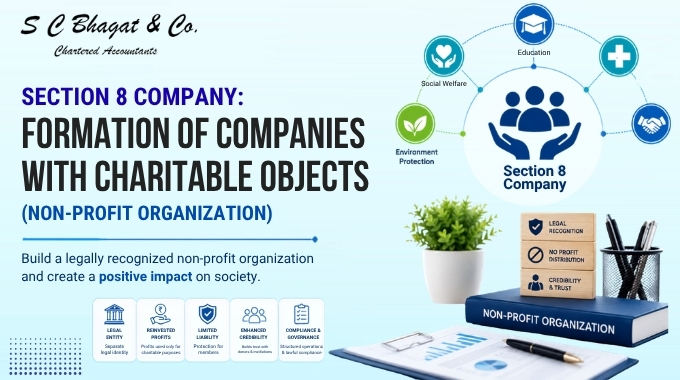
Many individuals and organizations in India aspire to make a positive social impact by working in areas such as education, healthcare, environmental protection, social welfare, rural development, and charitable activities. Establishing a Section 8 Company is one of the most credible and legally recognized ways to pursue these objectives while operating as a non-profit organization.
A Section 8 Company is governed by the Companies Act, 2013 and is formed to promote charitable or not-for-profit objectives. Unlike traditional companies, its profits are not distributed among members but are reinvested to further its mission.
If you are planning to establish an NGO, charitable institution, or social enterprise, understanding the formation process, legal requirements, and benefits of a Section 8 Company is essential.
What is a Section 8 Company?
A Section 8 Company is a company incorporated under Section 8 of the Companies Act, 2013 for promoting charitable, social, educational, scientific, cultural, environmental, sports, research, or other non-profit objectives.
Its primary purpose is to apply its income and profits solely toward achieving its stated objectives rather than distributing dividends to its members or directors.
Section 8 Companies are widely preferred by NGOs, charitable trusts, educational institutions, research organizations, and social enterprises due to their strong legal framework and high credibility.
Objectives of a Section 8 Company
A Section 8 Company may be established to promote one or more of the following objectives:
- Education
- Healthcare
- Social Welfare
- Poverty Alleviation
- Environmental Protection
- Rural Development
- Art and Culture
- Scientific Research
- Sports Promotion
- Women’s Empowerment
- Child Welfare
- Skill Development
- Animal Welfare
- Religious and Charitable Activities
The company’s Memorandum of Association (MOA) clearly defines these charitable objectives.
Key Features of a Section 8 Company
Some important characteristics include:
- Registered under the Companies Act, 2013
- Operates as a non-profit organization
- Profits are reinvested for charitable purposes
- No dividend distribution to members
- Separate legal entity
- Limited liability protection
- Perpetual succession
- Enhanced credibility among donors, institutions, and government agencies
Eligibility for Section 8 Company Registration
To incorporate a Section 8 Company:
- The proposed objectives must be charitable in nature.
- Income and profits must be used only for promoting these objectives.
- Members should not receive dividends or profit distributions.
- The company must comply with applicable provisions of the Companies Act.
Both individuals and corporate entities can become members or directors, subject to applicable legal requirements.
Documents Required for Section 8 Company Registration
The following documents are generally required:
For Directors
- PAN Card
- Aadhaar Card or Passport
- Passport-size Photograph
- Identity Proof
- Address Proof
- Email ID and Mobile Number
Registered Office Documents
- Electricity Bill or Utility Bill
- Rent Agreement (if applicable)
- No Objection Certificate (NOC) from the property owner
Other Documents
- Digital Signature Certificate (DSC)
- Director Identification Number (DIN)
- Memorandum of Association (MOA)
- Articles of Association (AOA)
- Declaration regarding charitable objectives
Step-by-Step Process for Section 8 Company Registration
Step 1: Obtain Digital Signature Certificate (DSC)
All proposed directors must obtain a valid Digital Signature Certificate for electronic filing.
Step 2: Apply for Director Identification Number (DIN)
DIN is mandatory for individuals intending to become company directors.
Step 3: Reserve the Company Name
An application is submitted to the Ministry of Corporate Affairs (MCA) for approval of the proposed company name.
The name should reflect the charitable nature and objectives of the organization.
Step 4: Draft MOA and AOA
The Memorandum and Articles of Association define:
- Objectives
- Governance structure
- Operational rules
- Member responsibilities
Step 5: File Incorporation Application
The incorporation application is submitted online along with all supporting documents.
Step 6: Issue of Certificate of Incorporation
Upon successful verification, the Registrar of Companies issues the Certificate of Incorporation, officially establishing the Section 8 Company.
Benefits of Registering a Section 8 Company
1. Separate Legal Identity
The company has its own legal existence independent of its members.
2. Limited Liability
Members’ liability is limited to their agreed contribution.
3. High Credibility
Section 8 Companies enjoy greater trust among:
- Government authorities
- Funding agencies
- CSR contributors
- Donors
- Financial institutions
4. Better Access to Funding
Many donors, CSR initiatives, and grant-making organizations prefer supporting registered Section 8 Companies.
5. Professional Governance
The Companies Act provides a structured governance framework that promotes accountability and transparency.
6. Perpetual Succession
The company continues to exist irrespective of changes in membership or management.
7. Tax Benefits (Subject to Applicable Registrations)
Eligible Section 8 Companies may apply for registrations under the Income Tax Act to avail tax-related benefits, subject to fulfilling prescribed conditions.
Compliance Requirements for Section 8 Companies
After incorporation, a Section 8 Company must comply with various legal requirements, including:
- Annual Financial Statements
- Annual Return Filing
- Board Meetings
- Maintenance of Statutory Registers
- Income Tax Return Filing
- Books of Accounts
- Audit Requirements (where applicable)
- ROC Compliance
Timely compliance helps maintain the company’s legal status and credibility.
Difference Between Section 8 Company, Trust, and Society
| Particulars | Section 8 Company | Trust | Society |
| Governing Law | Companies Act, 2013 | Indian Trusts Act/State Laws | Societies Registration Act |
| Legal Status | Separate Legal Entity | Depends on applicable law | Separate registered entity |
| Credibility | High | Moderate | Moderate |
| Governance | Structured | Comparatively flexible | Committee-based |
| Compliance | Higher | Moderate | Moderate |
| Suitable For | NGOs, CSR, Large Charitable Projects | Family/Private Charitable Activities | Community-Based Organizations |
Why Choose Professional Section 8 Company Registration Consultants?
The incorporation process requires legal documentation, regulatory filings, and compliance with MCA requirements.
Professional consultants assist with:
- Name Approval
- Documentation
- Drafting MOA & AOA
- MCA Filings
- Section 8 Company Registration
- Post-Incorporation Compliance
- PAN, TAN & GST Registration (if applicable)
- Ongoing Advisory Services
Professional guidance minimizes errors and speeds up the registration process.
Why Choose SC Bhagat & Co. for Section 8 Company Registration?
SC Bhagat & Co. provides end-to-end Section 8 Company Registration Services for NGOs, charitable institutions, educational organizations, and social enterprises across India.
Our services include:
- Section 8 Company Incorporation
- Company Name Approval
- DSC & DIN Assistance
- MOA & AOA Drafting
- MCA Filings
- ROC Compliance
- Accounting & Audit Support
- Income Tax & Regulatory Advisory
Our experienced Chartered Accountants and company law professionals ensure a smooth incorporation process while helping your organization remain fully compliant with applicable laws.
Conclusion
A Section 8 Company offers one of the most reliable and transparent legal structures for organizations dedicated to charitable and social objectives. Its robust governance framework, enhanced credibility, and ability to attract funding make it an ideal choice for NGOs, educational institutions, CSR initiatives, and non-profit organizations.
If you are planning to establish a charitable organization in India, professional guidance can simplify the registration process and ensure full legal compliance.
SC Bhagat & Co. offers comprehensive Section 8 Company Registration Services, helping organizations establish a strong legal foundation and focus on creating meaningful social impact.
Frequently Asked Questions (FAQs)
Q1. What is a Section 8 Company?
A Section 8 Company is a non-profit company registered under the Companies Act, 2013, to promote charitable, educational, social, environmental, or similar objectives.
Q2. Can a Section 8 Company distribute profits to its members?
No. Any income or profits must be used solely to achieve the company’s charitable objectives and cannot be distributed as dividends.
Q3. Who can register a Section 8 Company?
Individuals, professionals, entrepreneurs, NGOs, institutions, and organizations with charitable objectives can establish a Section 8 Company, subject to legal requirements.
Q4. Is GST registration mandatory for a Section 8 Company?
GST registration depends on the nature of activities and applicable turnover thresholds under GST law.
Q5. Why should I hire professionals for Section 8 Company registration?
Professional consultants help with documentation, MCA filings, legal compliance, drafting constitutional documents, and post-incorporation requirements, ensuring a smooth registration process.